
Age? – It’s Just A Number Really
Here’s a question for you. Do you know what the age statement means on your favourite bottles of whisky? It may seem like a daft question to ask but according to research commission by Chivas Brothers in July 2010 only 10% of you know that it refers to the youngest whisky in the bottle. Armed with this information Chivas Brothers launched a campaign called ‘Age Matters’. The blurb stated that ‘The aim of the campaign is to enable consumers to understand fully the age statement and to appreciate the value of the premium product they are purchasing’.
A lofty goal you may think, and you can’t argue with any attempt to educate the consumer is a worthy endeavour. However, this research also indicated that the vast majority of consumers believed that older whiskies are better quality. Well as you can imagine the marketing boys jumped on this and although this wasn’t exactly stated in the campaign it certainly was implied. Statements such as ‘…. It follows that the longer the maturation period (time spent in the cask) the more complex a whisky’.
In advertising parlance, what they wanted you, the consumer to do was trade up. Forget about our bog standard 10 year old and instead buy our luxury 21 or 30 year old, complete with all the bells and whistles packaging wise! Now I know that as a retailer we want to sell the more expensive whiskies, because, well, we make more money, but to imply that a whisky is better, simply because it has spent more time in a wooden barrel, is at best misleading and at worst downright dishonest because experience of tasting whisky has taught me that old does not always equate with being more complex or better. In fact, age and quality are two completely things and should be considered as totally separate entities. At the end of the day, every whisky, regardless of its age statement should be judged on its merits alone.

In my experience many, but not all whiskies reach their apogee in their mid-teens. It is at this point that the balance between the freshness of the spirit and the flavours imparted by the oak find a natural balance. That is not to say that younger whiskies are not any good, yes, they can sometimes be simpler in flavour but sometimes the beauty of those whiskies is that they are uncomplicated by wood extracts, and you can experience the full character of the spirit or distillery character to coin a phrase.
That is not to say that older or mature whiskies cannot be good. Over the years I have tasted some sublime old whiskies and again, they can be extremely complex but when you consider that a large proportion of those flavours will be derived from the cask it has been aged in, sometimes the spirit will have taken up too much wood character and become unbalanced. Occasionally these whiskies will just taste old and tired; especially if the cask wasn’t top quality shall we say.
So why does this happen, well, let’s take a look at what happens to whisky once it has been put into a cask. Although detailed research into this phenomenon has been going on since the 1970’s there is still a certain mystique surrounding the influence of oak on spirit. Essentially wood maturation can be broken down into three stages – Subtractive, additive and interactive. These stages are not linear and often they occur simultaneously, albeit at differing rate.
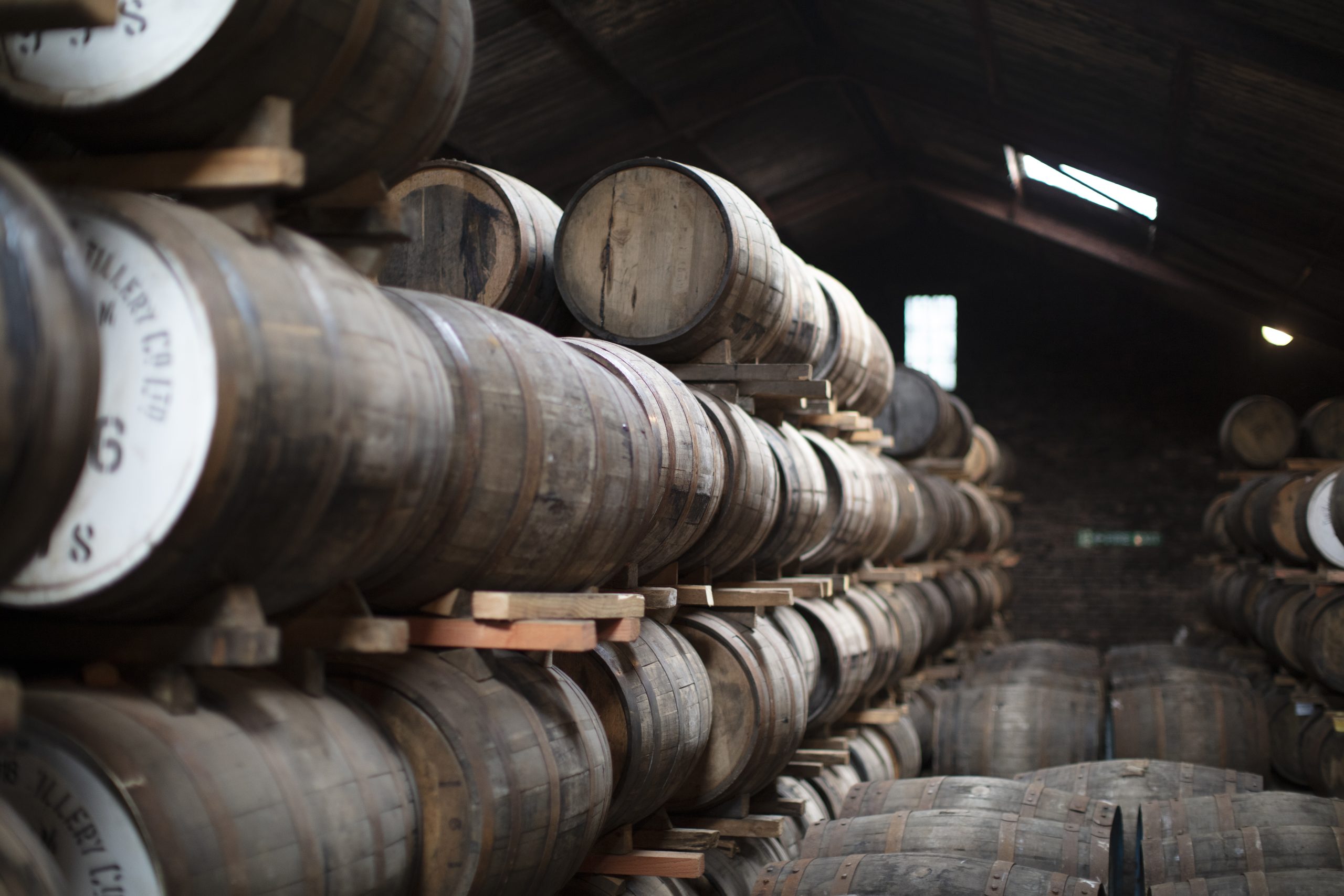
Firstly, subtractive maturation. Oak is a porous substance; this allows the spirit to seep into the wood. This allows the wood to reduce the levels of fusel oils, feints and sulphur present in the young spirit by absorption and by oxidation so that these flavours are transformed into subtler, less unappealing notes. However, as sulphur is often used to disinfect ex sherry casks these compounds may never be removed entirely. Ex bourbon casks are more effective in regard to removing these unwanted compounds because they are charred on the inside of the cask. This layer of char is usually between 2-4mm deep and it allows the spirit to seep further into the wood, thus making the process a lot more efficient.
So, onto additive maturation. Simply put this stage see’s the oak adding colour and character to the whisky. Oak is composed of cellulose, which is fairly inactive with regards to flavour extraction. Hemicellulose, which contains a number of different sugars which breakdown easily when heated (charred) they impart a range of compounds such as furfurals (almond, walnut), hydroxymethyfurfural (wax, butter, caramel), maltol (malt) and cyclotene (maple, liquorice, caramel). Another component is Lignin. Lignin’s are quite complex chemical structures comprised of molecules of a variety of sugars, acids and phenolic aldehydes, which when heated transform those compounds into very aromatic compounds called guaiacaol (smoke), 4-vinylguaiacol (clove), phenyl ethanol (rose), vanillin and vanillic acid.
If all that chemistry wasn’t enough then there’s more! We haven’t taken a look at oak wood extractives yet! These include eugenols (clove, cinnamon), β-damascenone (peach, cooked apple), hexanal (grass), trans-2-nonenal (saw dust, grease) and 2-octenal (green leaf, untoasted oak). Oak is also comprised of two different types of lactones. These are what give oak its distinctive ‘oakiness’. Firstly, the cis-oak lactone imparts a coconut/ vanilla character and then there is trans-lactone which imparts spicier coconut, clove and incense notes. Finally, we can’t ignore tannins. The tannins found in oak are less stable than those found in grape skins and pips, thus more volatile and active during maturation, they can impart a certain ‘smoothness’ to the whisky yet they can also impart a bitterness, which often tends to appear in the finish when tasting a whisky. This bitterness is not necessarily a bad thing as long as it is balanced by the other flavours.

After all that, there is what is termed interactive maturation. Again, simply put this is the term for how the whisky reacts with the wood extracts and with what the cask had originally held. As the whisky mingles with the liquid remaining within the staves it imparts those characteristics. Thus, ex-bourbon casks will impart additional vanilla, crème brûlée, almond, hazelnut and butterscotch along with a distinct sweetness, but arguably the most dramatic changes are imparted by ex-sherry casks, particularly those that held Oloroso or Pedro Ximenez sherry, which can give treacle, toffee, sultanas, raisins, plum, dark rich fruit cake gingerbread and walnuts. Also, ex wine casks can be used to impart further ‘winey fruit’flavours. Of course, the take up of all these different flavour compounds is also determined by how many times the cask has been re-used, this in whisky talk is what is referred to as the ‘fill’. Obviously ‘first fill’ casks (casks that have not previously held whisky) will impart a greater degree of these compounds and often quicker than a cask that has been filled a second or a third time.
The final part of the ‘alchemy’ of maturation is oxidation. As we know wood is porous, thus it can ‘breathe’. This means that there is an ingress of ‘fresh’ surrounding air and an egress of ‘saturated’ air. Many believe that if the fresh air is saturated with salt, for example, then that salt will find its way into the whisky. This is possibly the most contentious issue with regards to the whisky community and opinion is divided as to if this has any impact upon the supposed ‘coastal’ character of a number of whiskies that are matured in warehouses by the sea. But I digress. As a cask is not filled right to the brim it leaves what is known as a ‘headspace’. As the temperature surrounding the cask rises the whisky within the cask expands, as the headspace cannot expand into the whisky it effectively ‘exhales through the cask. When the temperature falls however, the whisky and the headspace contract, thus drawing air in from outside the cask. This process of oxidation helps the flavour components to find equilibrium but during extended maturation it also imparts a character which the French call ‘rancio’ that heavy, nutty, walnuty, mushroomy, earthy character which can be detected in an old Cognac.
Extended maturation also entails evaporation of the whisky, otherwise known as the angels share. Approximately 2% of the volume of the cask is lost in this manner each year. This in turn leads to an expansion of the headspace, which can lead to an extreme risk of over-maturation as the volume to surface ratio of oak increases, which in turn leads me back to why old whiskies are not necessarily better. Simply put the spirit over oxidises and loses the fruity esters and becomes crippled by the oak flavours, and I have tasted a number of whiskies, over the years that have succumbed to this.
It has to be said that these old whiskies are not cheap. Once you have spent several hundred pounds on a bottle the last thing that you want to find when you pour yourself a dram is that it really doesn’t live up to its price tag, which is why all our older bottlings are tasted by me to make sure that, you the customer are not disappointed, or should I say hopefully not disappointed.
Share


