
Peat – Where Does It Come From and What Does It Do?
The most usually asked question is: ‘Why is peat used in the whisky industry at all?’ In order to answer that we need to travel back in time and back to the very first part of the whisky making process, that being malting or conversion. In scientific terms malting is the controlled germination of cereals, followed by a termination of this natural process by the application of heat. This process modifies the cell wall material and the reserve proteins of the barley grain, preparing its starchy interior (endosperm) for conversion to sugars during the mashing process, which will feed the yeast to produce alcohol during the fermentation process.
What appears to be a very simple operation is fraught with danger as the maltster must manipulate the combination of water and air correctly in order to raise the moisture content of the grain to between 35% – 46% to start the germination process and allow a complete modification of the starchy endosperm. This is done by immersing the grain under water (or ‘steeping’) two or three times, followed by a rest in air (or withering) over a period of two to three days. If he misjudges the moisture content, then he would effectively drown the barley! During this resting period the barley begins the germination process. In traditional maltings this was done on the ‘germination floor’, where the grain was turned by shovel to prevent heat build up. As this was a very labour intensive method as well as being somewhat inefficient, the man with the shovel has now been replaced by a germination vessel fitted with a gentle mechanical turner in most modern maltings. These vessels also allow air to be blown through the grain bed from the underside. Often the air is humidified to help with temperature control, and to ensure that the grain does not dry out. This stage of the process can last between four to six days, and the resulting grains are now referred to as ‘green malt’. Once sufficient enzymes have been produced within the grain to allow the breakdown of the cell walls of the starch and its modification, but before the endosperm can be converted into a food source for the awakening roots and shoot that will form the new barley plant, the maltster stops the modification by applying heat. This process takes place in a kiln, and this is where peat enters the equation.
Up until the mid 1960’s and the introduction of industrial malting plants, such as those at Arbroath, Glen Esk, Port Ellen and Tamdhu, to name a few, most malting and kilning took place within the distillery itself, thus the most readily available fuel source for use in the kiln was peat, especially in areas where coal was not easily available. With the development of the railway network in Scotland and the advent of coke mining, the use of peat began to diminish as these more economical and cheaper fuels were introduced. The Speyside and Lowland distilleries were among the first to convert to the production of un-peated whiskies. Up until that point it was common for Lowland distilleries to use 25-50% peat, the Highland/ Speyside distilleries to use 50-75% peat and the Islay distilleries 100%.
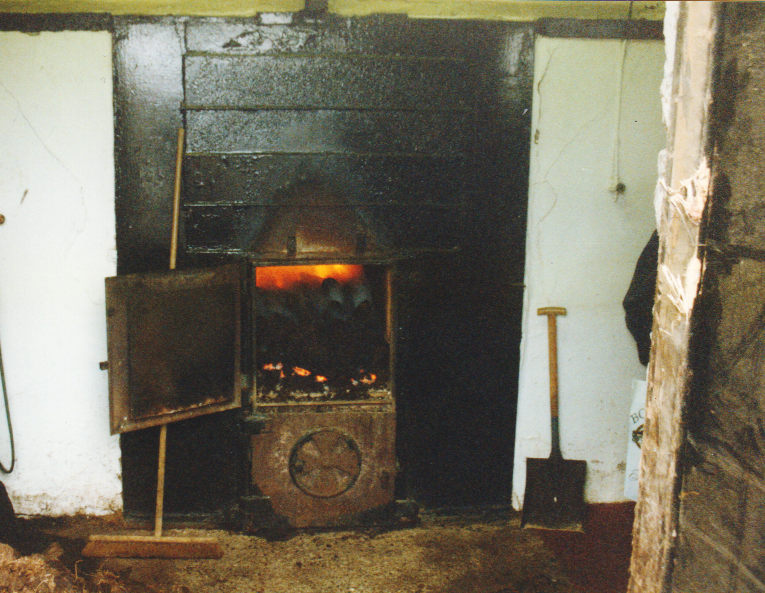
The kiln itself is a tower shaped structure with a furnace at the base. A hot air chamber above the furnace distributes the heat from the furnace evenly under the wedge wire floor on to which the grain has been spread. The wedge wire floor is so constructed as to allow an easy passage for the hot air to pass through the grain, this upward draught of hot air may be natural but is often assisted by fan power. Kilning is a complex, two part procedure. The first part is the drying stage. Ideally the grain will have been properly withered, which will result in the removal of 25-30% of moisture. The malt is then spread on the kiln, ideally at a depth not exceeding 7-8 inches and is left, preferably un-moved until it is hand-dry (that is to say, reduced to a moisture content of 12-15%). It is at this point that the malt is more susceptible to the absorption of peat smoke and phenols, thus the use of peat at this early stage of kilning is critical if the distillery wishes to produce a peated malt whisky. If that is the case then, they will order the malt to be peated to a certain concentration as in Part Per Million (ppm), which we will explore in detail further in the article. The so-called curing stage constitutes the last part of the kilning process, and the malt must then be turned frequently to ensure a uniform drying of the malt occurs, leaving it in a suitable condition for the processes of milling and mashing.

So, what exactly is peat? The Encyclopaedia Britannica’s definition is that it is an organic fuel consisting of spongy material formed by the partial decomposition of organic matter, primarily plant material, in wetlands. This plant material is usually referred to as sphagnum moss (also called peat moss or bog moss). The taxonomy (the conception, naming, and classification of organism groups) of the sphagnum species remains controversial, with various botanists accepting quite different numbers of species, which can be anywhere between 150-300 different varieties of plants, however in layman’s terms it means low growing plants such as bog cotton, bog myrtle, bog bean, heather, sedges, grasses and rushes.
Peatlands are classified by the manner in which they were created, either by heavy rain (ombotrophic) – Bogs or by waterlogging due to flooding (minerotrophic) – Fens, Marshes and Swamps. Bogs (blanket or featherbed) usually contain more sphagnum moss and less woody vegetation. Fens (otherwise known as basin or valley bogs) contain more sedges and grasses, thus being richer in carbohydrates. Marshes, which are treeless and subject to intermittent flooding accumulate peat very slowly and Swamps, which are very minerotrophic contain a lot of wood and nutrients. It is no surprise to learn that the composition of peat itself is roughly 90% water and 10% dry matter. This dry matter is predominantly organic, containing lignin (an integral part of the secondary cell walls of plants), cellulose and hemicellulose (both structural components of the primary cell wall of green plants) along with varying carbohydrates, depending upon the vegetation and bog type. Approximately 10% of Scotland is covered by blanket bogs, especially in the west and the islands and 1% by basin bogs.
These peat bogs have formed over thousands of years and consist of a number of layers. The upper layers are rich in carbohydrates and organic matter, which means that when it is burnt it creates more smoke, but less of the phenols which is what generates most of the so called ‘peat reek’. The lower levels, which contain more of these phenols such as guaiacols, furans and creosols (which produce the smoked meat and savory notes) also have increased levels of potentially harmful nitrogen and sulphur compounds. So, it would appear that not only is the bog location a significant factor in producing a ‘peaty’ aroma but the cutting depth as well.
Currently there are 24 peat bogs in Scotland that have permission for peat extraction. Of these 7 are used by commercial maltings. There are 3 located on Islay, Glenmachrie Moss (basin bog) which supplies Laphroaig, Gartbreck Moss (basin bog) which supplies Bowmore and Castlehill (blanket bog) which supplies the Port Ellen maltings. One is located on Orkney, Hobbister Hill (blanket bog) which supplies Highland Park and the final three are found on the mainland, those being St Fergus (basin bog) in Aberdeenshire, Tomintoul (basin bog) in Speyside which both supply a number of different maltings, and the last is located in Campbeltown, Machrihanish (blanket bog) which supplies Springbank and Glen Scotia.
A comprehensive study of these peat bogs was carried out in 2006 by Barry Harrison and his team for the Institute of Brewing. Using infrared spectroscopy on samples taken from various depths they concluded that there were considerable differences between peats from different origins. Islay peat is usually richer in phenols such as guaiacols, vanillic compounds and nitrogen but has less woody carbohydrates than mainland peat. It is assumed that it is because there is a greater degree of sphagnum moss and lesser wooden stemmed plants on the Island. Wooden plants, especially deciduous plants, contain greater amounts of syringol-based aromas as compared to phenol rich sphagnum and relatively guaiacol rich bog plants. Although the peat from Castlehill has a slightly different composition to the two basin bogs, which is probably down to the different microbiology of the blanket bog and a high degree of woody material.
Even though the Hobbister Hill bog is a blanket bog, analysis showed it to be chemically closer to the Islay basin bogs of Glenmachrie and Gartbreck than the Castlehill bog especially when the peat was cut from lower levels. This may be because it displays some basin bog features such as standing water, especially in the deeper layers along with the fact that heather tends to be relatively more abundant in peat deposits in the North of Scotland compared with the South West. An increased prominence of a particular plant species such as this may also have an effect on the chemical composition of the peat. As the Machrihanish bog was not included in this study it can only be presumed that since it is a blanket bog situated closer to the sea in Western Scotland that its peat is closer in style to that found on the islands.
The two mainland basin bogs of Tomintoul and St Fergus were found to be considerably different to the Island ones. Tomintoul contained a high amount of carbohydrates, as expected, but also a lot of sphagnum moss as well, although the phenol content was less than that found on Islay, which again could be down to the variety of sphagnum found in the East Highlands and the slightly different climatic conditions found there. St Fergus peat is rich in woody material and therefore contains a high degree of lignin derivatives, especially sringyl. Although it has less sphagnum moss than the peat from Tomintoul it does have a higher phenol content. It is possible that the closer proximity to the sea of the St Fergus bog might play some part in this because of differences in drainage and temperature stabilization.
So how does this difference in peat type affect the peat character of individual whiskies? The first point to consider is the peating level of the barley itself. As I mentioned earlier, malt is specified by measuring the phenol content by high performance liquid chromatography and this concentration is measured in Parts Per Million. Thus, lightly peated malt will have less than 5ppm of phenols, medium peated malt between 5-15 ppm and heavily peated malt 15-50 ppm. However this perception of peating boundaries has been challenged by Ardbeg, who released a bottling called Supernova which was peated to 100 ppm and Bruichladdich’s Octomore which has pushed the level up to 307.2 ppm. So, is anything above 50 ppm now considered to be super peated?
Anyway, just because it says 100 ppm on the tin it doesn’t mean that the finished spirit will have a concentration anywhere close to that. Some peat residue sticks to the husks of the barley which are removed during the milling process, also we have seen from the distillation process the highest concentration of phenols can be found in the feints but if the middle cut is left for too long then there is a risk of too many unwanted flavours entering the spirit, thus more of the phenols are lost. Finally, phenols decrease during maturation, although at present there is no conclusive proof to support either the theory that these phenols lose their pungency with time or whether the oak derived compounds become more prominent and thus mask the phenolic compounds. Either way if you take Lagavulin for example, its malt is peated to 35-40 ppm, but the levels of phenols fall to 21-25 ppm in the new make spirit. By the time it is 10 years old it has dropped to 8-10 ppm, by 15 years old 5-8 ppm and by 30 years old it has fallen to 4-6 ppm.
Finally, how does the location of where the peat come from impact upon the aromas and flavours of the spirit? Burnt sphagnum on its own releases relatively simple phenols, but when woody, carbohydrate derivatives are present it will produce a drier, more earthier style of spirit like that found in the in the peated spirit from Benriach, Tomintoul (however their Old Ballantruan bottlings does tend to have a greater Islay-like character) and to certain extent in the spirit from the Springbank distillery. Whereas those from Islay and the Islands tend to have more medicinal, creosote, iodine and herbal-peat reek, which is down to the higher proportion of carbonyls and guaiacols present in the peat. Without these carbonyls and guaiacols the phenols can taste quite hard and ashy like in the Benriach Birnie Moss bottling but together they can produce a wonderful savoury, smoked meat character as in Ledaig. These observations are only a rule of thumb as distilleries can source their peated malt from several different malting’s and obviously when they vat together spirit produced from different batches of malted barley they can resemble peated malts from other areas, but hey, that’s half the fun of blind tasting peated malts!
Share


